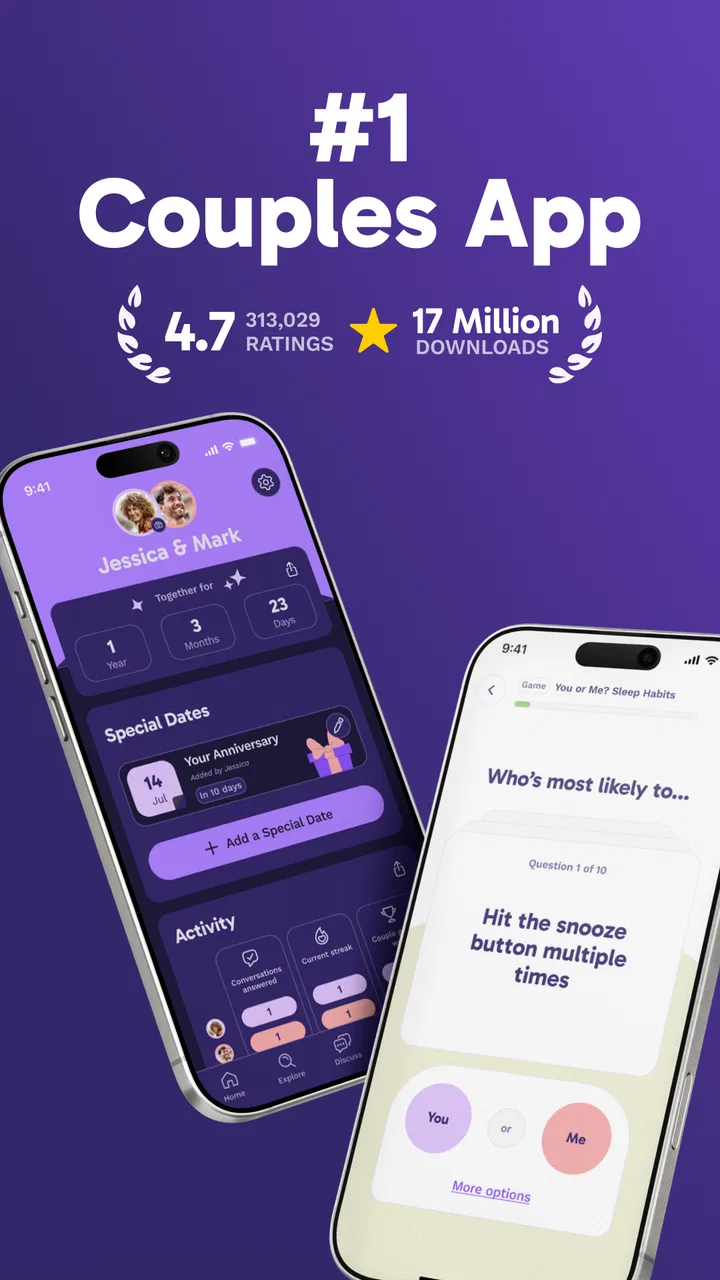
Paired: Couples & Relationship
- 4.6
- Rating
- 1.00M
- Installs
- Free
- Price

 Analysis by App-foxy
When a relationship feels busy rather than broken, finding a useful way to talk can be surprisingly difficult. Paired: Couples & Relationship is a lifestyle app built around questions, quizzes, advice, and games for couples. I found its main value in giving two people a gentle starting point instead of asking them to invent a serious conversation from nothing.
The app is developed by Paired - Relationship Advice & Quiz for Couples, and it is free to install. Its audience is clearly adults: the content rating is Mature 17+, which makes sense for an app that discusses romantic relationships and personal subjects. It has reached over one million installs and holds a 4.6 average from around 63 thousand ratings, so it is already a familiar option for couples looking beyond ordinary messaging or generic relationship articles.
My overall impression is positive, but with an important qualification: this is not a substitute for therapy, a solution for serious conflict, or a magic way to make an uninterested partner participate. It works best as a small, repeatable ritual for couples who want better conversations and need a little structure to begin.
You May Also Like

 Blood Strike: 2.5 Anniversary
Blood Strike’s Loadouts Turn Every Drop Into a Tactical Gamble
A close look at Blood Strike’s custom loadouts: how fast access to signature weapons reshapes its battle royale rhythm, rewards preparation, and narrows the gap between fights.

 Pandora - Music & Podcasts
Pandora’s Music Is Easy to Start, but Harder to Recover
Pandora’s strength is its low-effort path from a seed to a station. Its weak spot is how much confidence it asks you to place in connection, setup, and quiet recovery.

 8 Ball Pool
 Is Built on Rivalries, Rematches, and Routine
A close look at the rivalries, rematches, shared routines, and unanswered safety questions that turn a quick pool match into a persistent mobile community.

 Samsung Music
’s Quiet Strength Is Playing What You Already Own
Its reach comes less from spectacle than from dependable access to a personal library. That simplicity is both the app’s strongest retention engine and its ceiling.

 AccuWeather: Weather Radar
AccuWeather Review: A Quick, Clear Forecast for Everyday Decisions
For everyday plans, the best forecast is the one you can understand quickly. AccuWeather makes rain timing, radar, and local conditions easy to act on, with a few trade-offs.

 Hill Climb Racing
Why Hill Climb Racing Still Turns Crashes Into One More Run
A tiny car, a bumpy hill and one more upgrade: Hill Climb Racing keeps resurfacing because its simple chaos makes every near-miss feel personal.
More From Our News Desk



What to expect before you begin
The first thing to understand is that Paired is not primarily a private journal or a conventional advice library. Its strongest idea is shared participation. You answer prompts, compare perspectives, and use the result as a reason to talk. That changes the experience from “I should read about relationships” to “we have something specific to discuss tonight.”
That distinction matters in everyday use. A long article about communication may be sensible, but it can be hard to turn into action after a tiring day. A focused question is easier to answer. It can reveal that two people remember the same event differently, value different forms of support, or have simply stopped asking one another about ordinary feelings.
I would approach the app with modest expectations. The advice and quizzes can help you notice patterns, but they do not know your relationship in the way you do. A result should be treated as a conversation prompt, not a diagnosis. If a question produces disagreement, that is not automatically a bad outcome. Sometimes the useful result is discovering where assumptions have replaced an actual conversation.
There is also a practical distinction between the free experience and optional paid content. Paired is free, while in-app purchases range from $0.99 to $99.99 per item. I recommend using the initial experience long enough to decide whether both partners genuinely enjoy the format before spending money. A subscription or purchase is only worthwhile if the app becomes part of your routine rather than something opened once during a burst of enthusiasm.
Who will get the most from it
I think Paired is especially suitable for couples who are doing reasonably well but feel repetitive, distracted, or out of practice when it comes to meaningful conversation. It can also help partners who live apart, have different schedules, or want an intentional check-in that does not feel as formal as a relationship meeting.
Newer couples may appreciate the way prompts surface expectations that otherwise stay hidden. Long-term partners can use it to revisit topics they assumed they already understood. Even couples who communicate well may enjoy the quizzes and games as a low-pressure way to introduce variety.
I would be more cautious if one partner is being pressured to use it. Shared relationship tools only work when participation is voluntary. It is also not the right first step for abuse, threats, coercive control, or a crisis involving immediate safety. In those situations, personal safety and qualified professional support matter far more than completing a prompt together.
Starting without making it awkward
My advice is to present Paired as an invitation, not an assignment. Saying “let’s see what this asks us” is more welcoming than announcing that the relationship needs fixing. The tone you bring to the first session will affect the answers more than any particular quiz.
Choose a moment when neither person is rushing. A short session after dinner or during a quiet weekend is better than opening the app in the middle of an argument. Keep the first attempt small. The goal is not to cover every topic; it is to discover whether the format makes talking easier.
One useful habit is to agree in advance that an answer will not be used as ammunition later. That does not mean avoiding honest responses. It means creating enough trust for honesty to be useful. If one person expects a defensive debate after every answer, even a well-written prompt will feel like an interrogation.
Setting up the first meaningful session
The setup is easiest when both partners treat the app as a shared space rather than one person’s private project. Install it on the device you normally use for couple activities, open it together, and take a minute to understand how the current activity is presented before answering quickly. The app’s purpose becomes clearer when you experience the flow as a pair.
I would not begin by trying to optimize every category or chase the most serious subject. Start with a question that feels answerable on an ordinary day. A lighter prompt can establish the rhythm: read, answer honestly, compare, and discuss. Once that rhythm feels natural, more personal topics are less likely to seem abrupt.
When answering, avoid negotiating the “correct” response. The point is not to match. If the app asks about preferences, expectations, or feelings, each person should answer from their own perspective. A difference is often more informative than agreement because it tells you where a follow-up question is needed.
A practical approach is to give each answer a little context. Instead of choosing a response and moving on, add one sentence explaining why. For example, if a prompt touches on support during a stressful week, explain what support looked like recently. This turns a quiz interaction into a concrete conversation about real behavior.
A realistic first-use scenario
Imagine a couple who both arrive home tired. They have not had a serious disagreement, but their evenings have become logistical: food, chores, messages, sleep. One partner suggests trying Paired for ten minutes without expecting a major breakthrough.
They choose a prompt and answer separately. Their responses are not identical, and one person realizes that the other has been interpreting “help” as practical assistance while wanting emotional attention instead. Nobody has solved the relationship in one sitting, but they now have a specific example to discuss. They decide that the next time work becomes overwhelming, they will ask directly whether the other person wants listening, advice, or hands-on help.
That is the kind of success I would look for. The app does not need to create a dramatic revelation. If it helps replace a vague feeling with a clear question and one manageable change, it has done something worthwhile.
How to make quizzes and games useful
Quizzes are tempting to treat like tests, especially when partners compare answers. Try not to turn them into a scorecard. A matching answer can be reassuring, but it does not prove that the topic is fully understood. A different answer is not a failure; it is an opportunity to ask, “What made you choose that?”
The games are most useful when you use them to lower the pressure before a deeper discussion. They can provide a playful entry point for couples who find direct emotional questions uncomfortable. However, if both people are exhausted or irritated, even a game can feel like another task. Pausing is better than forcing a cheerful performance.
Advice works best when you translate it into one behavior. If a suggestion concerns listening, decide what listening will look like during your next conversation. If it concerns appreciation, choose a specific moment to express it rather than leaving the idea at the level of a general intention.
The hidden advantage is not the individual prompt; it is the repeatable conversation pattern. Reading a relationship tip once rarely changes much. Repeatedly answering, comparing, and following up can make reflection easier to remember, especially for couples who otherwise only talk about problems when they become urgent.
What can confuse first-time users
The biggest possible misunderstanding is expecting the app to deliver identical experiences to both partners at all times. Shared relationship tools depend on timing, honesty, and willingness. If one person answers casually while the other treats every question seriously, the mismatch may feel like an app problem when it is really a difference in expectations.
Another point of confusion is the meaning of an answer. A response captures a feeling or preference at that moment; it should not be treated as a permanent label. People answer differently after a stressful week, a major life change, or a difficult conversation. Repeating a topic later can be useful precisely because the context has changed.
Some couples may also wonder whether they need to discuss every result immediately. I would not. If a prompt opens a sensitive subject at an inconvenient time, acknowledge it and agree on a better moment. A tool intended to improve communication should not become a reason to ignore practical boundaries.
Finally, remember that free access and optional purchases are not the same thing. You can begin without paying, but some content may be presented as an upgrade. Do not interpret a locked item as evidence that the basic experience is useless. First decide whether the core format suits both of you; only then consider whether additional content is worth the cost.
Privacy, comfort, and emotional boundaries
Because the app deals with personal relationship subjects, I would use it in a setting where both people feel comfortable. Avoid answering sensitive prompts while someone else is looking over your shoulder or while one partner is worried about how a response might be used. The quality of the conversation depends on emotional safety as much as on the wording of the question.
I also recommend taking screenshots or saving nothing unless you have both agreed that it is appropriate. The app is most helpful when it supports a conversation, not when answers become evidence in a future disagreement. If a topic repeatedly causes distress, step away from the activity and talk privately or seek qualified help.
For couples with different communication styles, a useful compromise is to allow quiet thinking time. One person may answer immediately, while another needs a few minutes. Rushing the slower partner can turn a reflective exercise into a performance. Giving both people room often produces more honest answers.
What to do after the first session
After trying one activity, resist the urge to measure success by how long you stayed in the app. A better measure is whether you had one conversation you would not otherwise have had. If the answer is yes, create a small routine that fits your life. It might be a short session once a week, a prompt during a long-distance call, or an occasional activity when the relationship feels stuck in autopilot.
Keep the follow-up concrete. Choose one insight and turn it into an experiment for the coming days. If you discovered that one partner wants more verbal reassurance, agree on a realistic way to offer it. If you noticed different ideas about quality time, schedule one activity and clarify what each person hopes to get from it.
Do not make every session serious. Alternating reflective questions with lighter games can prevent the app from becoming associated only with problems. That balance is one reason I see it as more approachable than a relationship book used only during conflict.
How it compares with familiar alternatives
Compared with searching the web for relationship advice, Paired gives you a shared starting point and a reason to respond together. Online articles are often better when you need detailed background, expert explanation, or help with a very specific issue. Paired is better when the main obstacle is getting the conversation started.
Compared with couples therapy, it is far less personalized and cannot observe patterns, challenge avoidance, or manage a difficult session. Therapy is the stronger choice for recurring conflict, grief, betrayal, trauma, or communication that has become unsafe. Paired can complement professional support for some couples, but it should not be used to postpone help when help is needed.
Compared with a shared notes app or a calendar, it offers more direction. Those ordinary tools are excellent for planning dates, recording goals, or tracking practical commitments, but they do not provide the same conversational structure. On the other hand, a simple walk and an honest question may work better for couples who dislike guided activities or feel that app-based intimacy is artificial.
Who should skip it
I would skip Paired if you want a fully private self-help app that does not involve a partner. I would also skip it if you dislike quizzes, prompts, or guided relationship exercises; forcing yourself through a format you resent will not improve communication. Couples looking for clinical assessment, crisis intervention, or highly tailored counseling should choose a qualified professional instead.
It may also be a poor fit when one partner is using every answer to prove that the other is wrong. No app can repair a basic lack of respect. In that situation, the most useful next step is an honest conversation about boundaries and support, not another activity.
My final recommendation
Paired is a thoughtful, accessible way to create small openings for better couple conversations. I like that it turns an abstract goal—“we should communicate more”—into a specific action that can happen during an ordinary evening. Its questions, quizzes, advice, and games are most effective when you use them as starting points rather than final answers.
The current version is 26.33.0, and the app supports devices running at least OS 7.1. With a free starting point, it is easy to test without committing financially, while optional purchases give frequent users a path to more content. The Mature 17+ rating is worth remembering before introducing it to younger users.
My advice to a first-time user is simple: install it together, choose one approachable activity, answer without trying to impress one another, and finish by naming one small action you can take outside the app. If that process feels natural, Paired may become a useful relationship ritual. If it feels forced, put it aside without guilt. The best relationship tool is the one that helps both people speak more openly, and for many couples this app can provide that first, manageable step.
FAQs for Paired: Couples & Relationship
01What is Paired: Couples & Relationship, and what can I use it for?
Paired is a relationship app designed to help couples communicate more openly, understand each other’s perspectives, and build healthier daily habits together. It offers conversation questions, quizzes, guided exercises, and relationship-focused activities covering topics such as communication, intimacy, conflict, finances, family, and future plans. It can be used by couples at different stages, whether they want to strengthen an already healthy relationship or work through recurring challenges.
02Do both partners need to download Paired for it to be useful?
Both partners do not necessarily have to install the app for you to explore its content, but Paired is most effective when both people participate. The app is designed around shared questions, answers, and activities that encourage couples to discuss subjects they may not normally raise. If only one partner uses it, they can still learn from the exercises and bring ideas into conversations, although some connected features may require an invitation or participation from the other person.
03Is Paired free to download, and does it require a subscription?
Paired can generally be downloaded for free, but access to the complete collection of questions, quizzes, exercises, and relationship programs may require a paid subscription. The exact price, trial availability, billing period, and included features can vary by platform, region, and promotional offer. Before confirming a trial or subscription, review the payment screen carefully, including renewal terms, and manage cancellation through your Apple App Store or Google Play settings.
04Is Paired suitable for couples experiencing serious relationship problems?
Paired may be helpful for improving everyday communication and encouraging constructive conversations, but it should not be considered a replacement for professional couples therapy, medical care, or crisis support. Some activities can bring up sensitive emotions, so couples should use the app at a comfortable pace and avoid forcing a discussion when either person feels overwhelmed. For abuse, threats, severe distress, or safety concerns, contact a qualified professional or appropriate emergency service instead.
05How private are our answers and relationship conversations in Paired?
Because Paired involves personal relationship information, privacy is an important consideration before using it. Review the app’s current privacy policy, account settings, and permission requests to understand how answers, profile details, usage data, and partner connections are handled. Avoid entering highly sensitive information unless you are comfortable with the stated data practices. You should also use a secure device account and keep the app updated, since privacy features and policies can change over time.
Pros
- Daily questions encourage meaningful conversations and emotional openness.
- Simple interface makes it easy for both partners to participate regularly.
- Progress tracking helps couples notice communication habits over time.
- Useful prompts support couples who struggle to start deeper discussions.
- Works well for long-distance relationships and busy couples.
Cons
- Many advanced exercises and insights require a paid subscription.
- Some prompts may feel repetitive after extended daily use.
- Both partners need consistent participation for the app to be effective.
- Personal relationship data may concern users who prioritize privacy.
- The advice may feel too general for complex relationship problems.

Paired: Couples & Relationship
Gallery